
Martin County Parole and Probation
Three forms of community supervision are often called parole, but North Carolina treats them separately. Probation is a community sentence imposed by a court. It may begin without any state-prison stay. Post-release supervision starts when a person serving a current Structured Sentencing felony leaves prison for a required period of supervision. Parole is a conditional release decision that generally concerns older-law cases that remain parole eligible. The North Carolina Post-Release Supervision and Parole Commission sets post-release conditions and makes parole decisions in eligible cases.
A prison exit does not always end the sentence. Someone may be physically outside an NCDAC institution while still listed as active in the community. The words on the offender detail matter more than a broad label. Review the dates, episode type, assigned office, and termination information together before drawing a conclusion.
| Supervision type | How it begins | What to verify |
|---|---|---|
| Probation | A Martin County court orders a community sentence | Judgment, active episode, assigned office, and end date |
| Post-release supervision | A qualifying state prisoner exits prison under required supervision | Prison release date, conditions, office, and final termination |
| Parole | The Commission grants conditional release in an eligible older-law case | Commission action, release episode, conditions, and discharge |
- Discharge
- The formal end of the supervision or sentence episode.
- Absconder
- A person reported as not complying or whose location is not known during active supervision.
- Revocation
- An official action that can end community supervision and return a person to custody after due process.
- Detainer
- A request by another authority to hold or notify before release.
Verify Martin County Post-Release Supervision
The strongest public starting point is the NCDAC Offender Public Information Search. It offers All, Active Inmate, Active Probationer/Parolee, and Inactive categories. A known offender number is the best first key. A name search should be checked against date of birth and other identifiers, then opened to inspect the complete incarceration and supervision history.
- Search All using the offender number, or use the full name with enough identifying detail to distinguish similar records.
- Repeat the search under Active Probationer/Parolee. A match there can describe someone released from prison who remains under community supervision.
- Open the matching record. Read the episode type, start and end dates, office information, and any termination entry rather than relying on one status word.
- Check Inactive if no active record appears. An inactive category is not, by itself, proof of final discharge or proof of a Martin County jail release.
- Confirm a disputed or time-sensitive result with the assigned office or NCDAC Community Supervision. Ask which episode remains open and whether a discharge order exists.
The NCDAC Community Supervision page shows how the statewide division is organized.
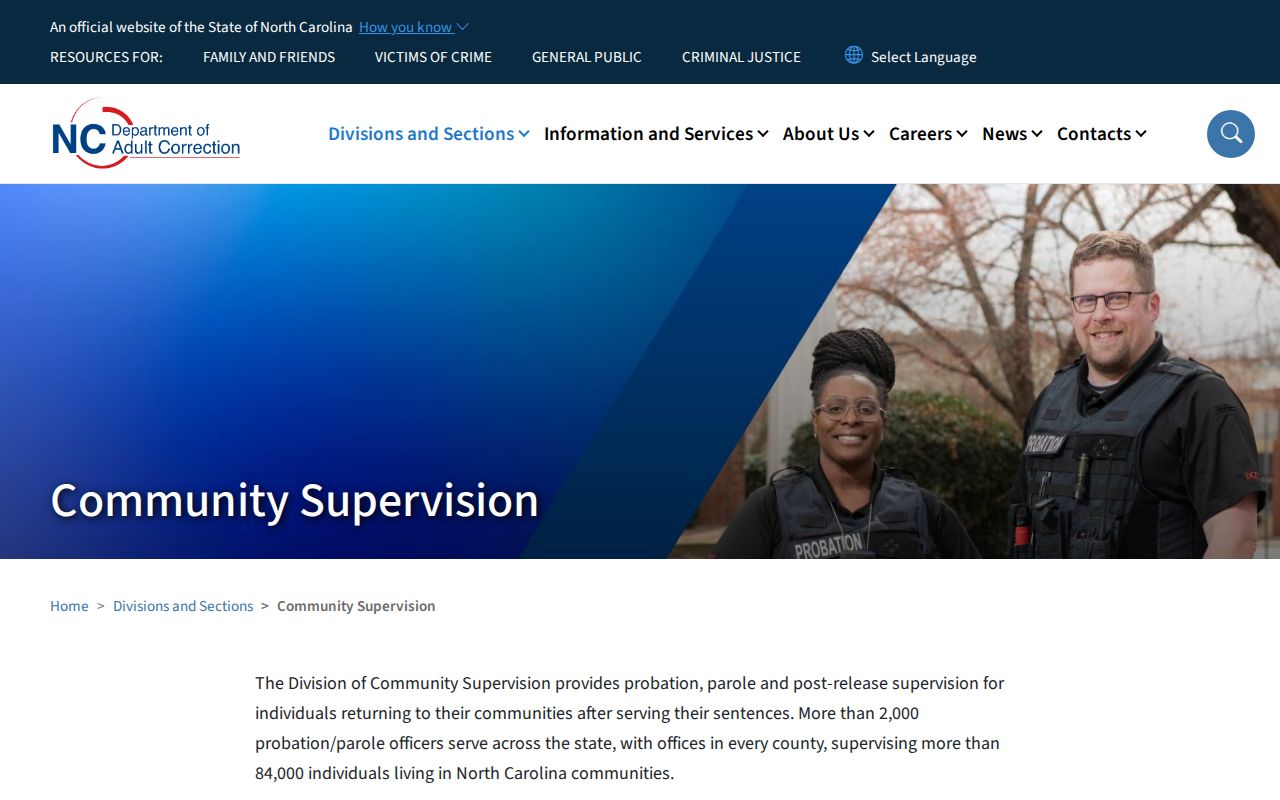
This agency view identifies the state system responsible for probation, parole, and post-release supervision rather than local jail custody.
Martin County Supervision Office Routing
NCDAC says community-supervision offices operate in every county and groups Martin with Beaufort, Hyde, and Tyrrell. Local assignments can change. Use the live office directory or the office shown on the person’s current offender record before traveling or sending documents. The statewide division can route a Martin inquiry when the local listing is unclear.
NCDAC Division of Community Supervision2020 Yonkers Road, MSC 4250
Raleigh, NC 27699-4250
Phone: 919-716-3100
Fax: 919-324-6247
Local office: confirm through the current NCDAC directory
The statewide contact is not the custodian for a Bertie–Martin Regional Jail booking or release summary. County-jail release proof belongs with the regional jail and relevant Martin court record. State supervision staff address an NCDAC community episode. Keeping those records separate avoids treating a local bond release, a state-prison release, and a supervision discharge as the same event.
Why Martin Releases Stay Active
A person can be physically released from a North Carolina prison yet remain “active” in the NCDAC public search. That category can refer to active community supervision rather than confinement inside an institution. The status is especially important for a Martin-connected person because no state prison is located in Martin County. The person may have served time elsewhere in North Carolina, returned to the community, and then reported through a field office serving Martin.
Read the custody and supervision rows as a timeline. A prison-release date marks departure from that custody setting. A post-release start shows the next legal stage. A termination or discharge entry identifies when that stage ended. If the record instead shifts to another institution or authority, the event may have been a transfer. The Martin County released-inmate search paths explain how jail, court, and state records fit together when more than one system appears.
Note: “Active Probationer/Parolee” can identify a released person in the community and should not be read as an in-prison label.
Martin County Absconder Status Checks
NCDAC maintains a separate absconder search. An absconder result indicates an unresolved active-supervision issue, usually because the person allegedly stopped complying or cannot be located. It does not prove a new conviction. It also does not prove that the person is physically in a jail. Treat it as a direction to contact the listed supervising authority.
The search should follow, not replace, the main offender-record review. Match identifiers carefully and note the date of the result. A stale jail listing cannot resolve whether supervision is active, and a missing local roster entry says little because no official Martin online jail roster was found. The assigned office can explain the current supervision record and whether another authority has taken custody.
The official NCDAC absconder screen shows the separate lookup used for unresolved supervision cases.
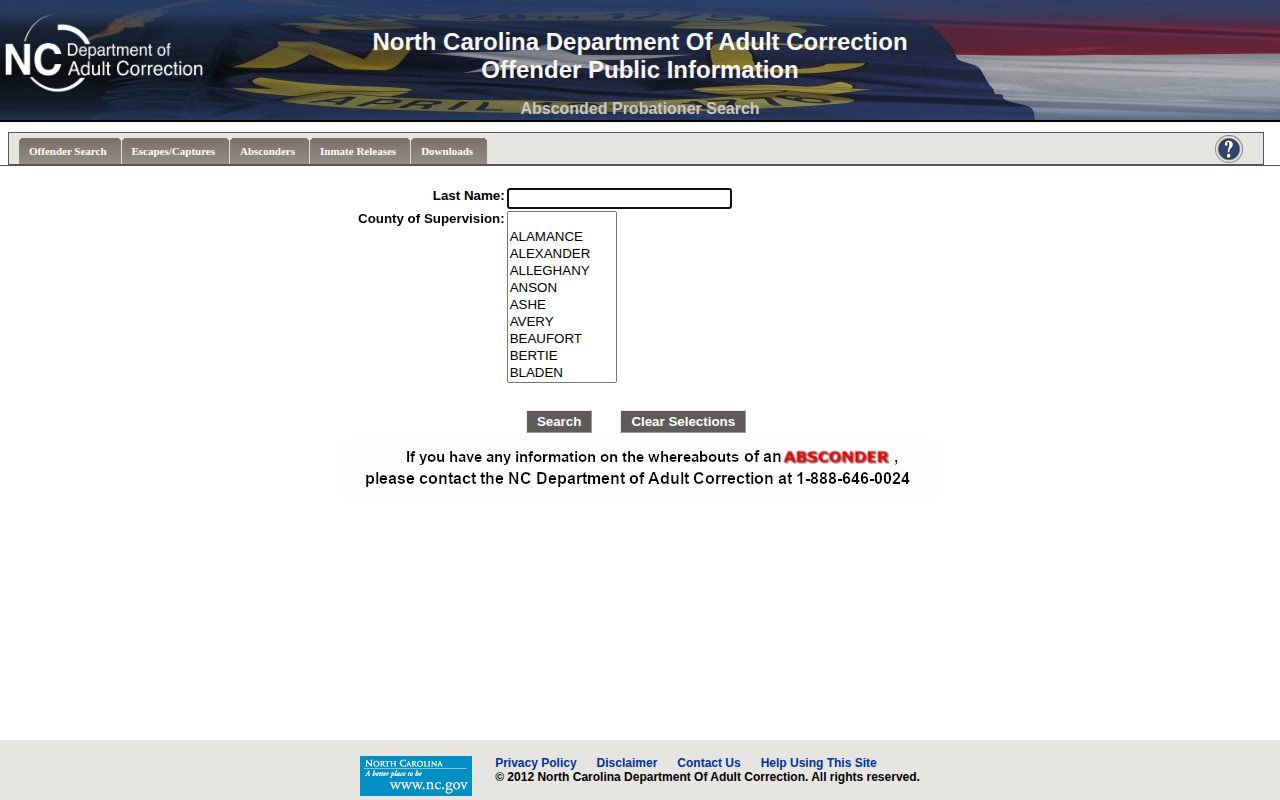
Its separate placement is a useful warning: an absconder flag concerns supervision status, not a final discharge record or a current jail roster.
Martin County Supervision Change Notices
NC SAVAN, accessed through VINELink, can provide notices about probation and parole events reported by participating systems. Researched event types include condition changes, revocation-related hearings and outcomes, movement into or out of intermediate sanctions, absconding, capture, termination, discharge, and death. A registered recipient can use those alerts to learn that the record changed.
An alert is not the underlying order. It may omit the full reason or legal authority. Compare the notice with the NCDAC offender episode, supervising-office information, and any court or Commission order. If a result says released or out of custody, interpret it as a status from the reporting agency only. Another detainer, supervision term, or custody system may still apply.
Martin Parole Reviews Have No Hearings
North Carolina does not publish the type of offender-by-offender formal parole hearing calendar used in some states. The Commission says it does not hold formal parole hearings and ordinarily does not meet personally with offenders during review. A search for a public weekly hearing date will therefore lead to the wrong model. General Public Information Meetings and victim meetings allow input near a review, but they are not open adjudicatory hearings where the Commission decides the case in public.
The official substitute is the Commission’s Discretionary Parole Reviews series. It publishes monthly reports beginning in September 2024. Those reports supply a decisions-and-results cadence for parole-eligible older-law cases. Eligibility is only a threshold for review, not a promise of release. G.S. 15A-1371 governs relevant eligibility questions, while the Commission may weigh risk, seriousness, treatment needs, and future conduct.
The Commission’s official overview states the no-formal-hearings practice.
This distinction prevents a public input meeting or monthly report from being described as a formal hearing or proof that a Martin-connected person was released.
Martin Parole Conditions and Violations
Conditions are the enforceable rules attached to probation, post-release supervision, or parole. They vary by the judgment, Commission action, and individual plan. Public status tools do not necessarily display the full signed conditions. The supervising officer, court file, or Commission record is the sound source for the terms in a specific case.
A reported violation is not the same as a final revocation. NC SAVAN may notify about a revocation-related event, but the resulting order controls. Intermediate sanctions may alter how supervision is served without ending it. When custody occurs after a violation, identify the authority holding the person and the episode involved. The Bertie–Martin Regional Jail, NCDAC, and another county can each hold different pieces of that history.
Martin County Supervision Discharge Records
Supervision ends through a formal termination or discharge, not merely because a projected date passed or a person stopped appearing in one search category. Look for an end date in the NCDAC episode, then obtain the relevant order when documentary proof matters. A completed probation case may also have a Martin court record. An older parole case may involve a Commission action.
North Carolina public-records law permits access to defined public records, but it does not make every offender detail public. Chapter 132 governs public-record access, while confidentiality, sealed matters, juvenile restrictions, and expunction orders still apply. A focused request should name the person, offender number, supervision episode, and public start, termination, or discharge fields sought. Ask the custodian to state the basis for any withholding.
Final discharge should remain distinct from release to supervision. One ends the community episode. The other begins it. That difference is the key to reading Martin County parole and probation records accurately.