
Martin County Projected vs Actual Release
The North Carolina Department of Adult Correction uses the phrase projected release date. It is an estimate built from the controlling judgment, sentence structure, court-ordered jail credit, release-to-supervision rules, and current earned or disciplinary credits. State law also uses the idea of a projected date by which a defendant can be released. Neither term is a promise that a person will leave custody on that day.
G.S. 15A-836 directs that a qualifying projected date be calculated as exactly as possible and account for earned-time and disciplinary credits. That statutory phrase still describes a forecast based on facts then known. It does not displace the later custody record, and it does not create a public regional-jail release feed. For a named Martin County person, the record label and the office controlling the sentence remain essential.
An actual release date records an event that occurred. It can describe a release to the community, an exit from prison into post-release supervision, or a transfer out of one custodian. Those events are not interchangeable. A person leaving Bertie-Martin Regional Jail for NCDAC has left regional-jail custody but has not been released from confinement. A state prisoner beginning supervision has left the prison building but has not necessarily reached final sentence discharge.
A pretrial detainee presents a different issue. No sentence calculation exists before judgment. Release can depend on bond conditions, dismissal, a court order, or another legal event, plus a check for other holds. For that person, the Martin court file and the physical custodian are more useful than a projected-date field.
Find a Martin County Release Date
Start with the last custody system. NCDAC’s Offender Public Information Search covers North Carolina state prisoners, probationers, and parolees, with historical data stated to reach back to 1972. It expressly excludes county and city jails. Therefore, it can show a state episode linked to a Martin County person but cannot calculate a bond-out or local release from Bertie-Martin Regional Jail.
- Identify whether the person is pretrial, serving a local sentence, or serving a state sentence.
- For NCDAC, search by offender number when known, or by name with status set to All.
- Compare birth date and other identifiers, then open every matching episode.
- Repeat under Inactive if the person may have left state custody.
- Check Active Probationer/Parolee if the person may be outside prison under supervision.
- For local custody, ask the regional jail for its calculation and match it to the Martin judgment.
The public state form also offers first and last name, middle initial, a sounds-like option, gender, race, ethnic group, birth-date tolerances, and age range. A known offender number is the strongest starting field. A single status word is not enough. Read the complete incarceration, offense, and supervision history so that an active supervision episode is not mistaken for prison confinement.
Note: An inactive NCDAC record is not automatically final discharge and never proves release from Bertie-Martin Regional Jail.
NCDAC Tools for Martin County Releases
NCDAC maintains two relevant public routes. The Offender Public Information Search is the person-centered tool. The separate Inmate Release Search works by release county, year, month, or name. Its form includes Martin as county code 58, plus options for a release county not reported and releases to other states. The available years are live choices that can change, so the form should be read as it appears rather than described as having a fixed retention period.
The release-county field needs careful labeling. Selecting Martin in the monthly NCDAC tool finds state-prison records carrying Martin as the release county. It is not a rolling list of people who left Bertie-Martin Regional Jail. The regional jail is a separate local custodian, and no official online local roster or release archive was found in the research.
The successful manifest image is sourced from the official NCDAC offender search used to open a state offender record.
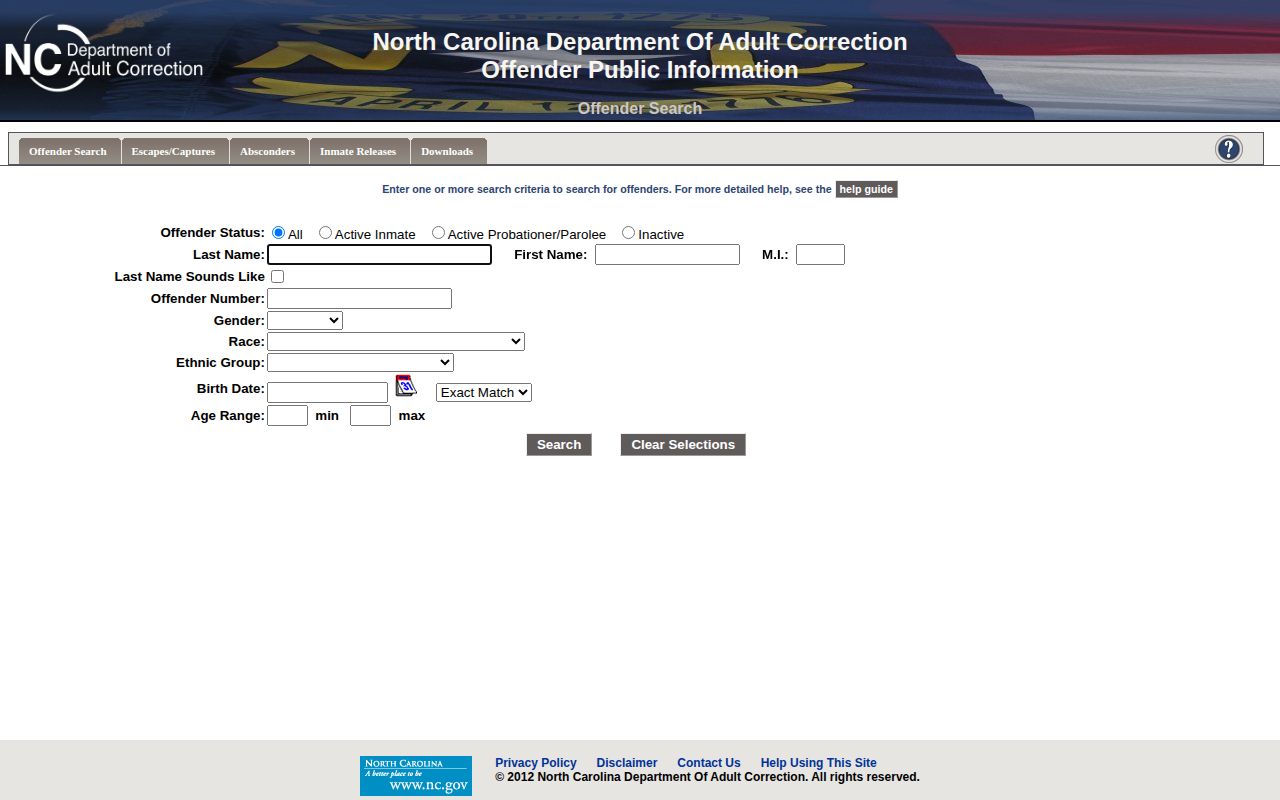
The search page is the entry point; the useful release answer comes from the matching person’s actual episode and projected-release field, when that field is exposed.
When an online state record remains unclear, NCDAC’s public-records office is the fallback. A focused request can ask for public admission and release dates, sentence length, time served, release type, and supervision status. NCDAC warns that most offender records are confidential and directs county-jail questions back to the local custodian.
Martin County Felony Release Is Not 85%
This North Carolina rule is the required distinctive point for a Martin County projected release date. Under G.S. 15A-1340.13(d), a current Structured Sentencing felony offender with active punishment serves the judicial minimum. Earned time may reduce the maximum, but it cannot reduce the term below that minimum. NCDAC summarizes the rule as serving 100 percent of the minimum, with court-ordered jail credit applied.
That makes the common 85-percent shorthand inaccurate for this framework. The safe description is conceptual: start with the imposed sentence, apply lawful jail credit and earned-time rules, account for the release-to-supervision structure, and do not use earned time to move below the imposed minimum. A public page should not attempt a named person’s arithmetic from a news report or assume the maximum sentence date is the projected date.
Post-release supervision also changes the apparent endpoint. Under G.S. 15A-1368.2, qualifying Structured Sentencing felons leave prison for supervised community custody according to the statutory framework. The research identifies general supervision intervals of 12 months for Class B1 through E and nine months for Class F through I, with a 60-month rule for specified maximums. Prison exit begins supervision in those cases; it is not final discharge.
The official NCDAC Victim Support Services explanation is also captured in the project manifest.
This source supports the North Carolina calculation context, while the person-specific NCDAC record remains the place to read the displayed projection.
Martin County Jail Release Calculations
A locally administered sentence does not acquire an NCDAC projected date merely because the case arose in Martin County. For a sentenced person held through Bertie-Martin Regional Jail, use the Martin County judgment and ask the jail custodian for the computed date. The jail can also say whether another hold, commitment, or transfer affects the physical exit. Martin County Sheriff may hold arrest or transport records, but it is not the jail operator.
G.S. 15A-1340.20(d) permits earned time on an activated misdemeanor sentence and caps the combined credit at four days per month. G.S. 148-13 authorizes NCDAC credit rules and requires applicable rules to be followed by local jail administrators for relevant sentenced prisoners. These laws provide a framework and ceiling. They do not publish Bertie-Martin’s calculation for a named person online.
Impaired-driving sentences and older cases may follow different rules. Fair Sentencing cases can involve older good-time and merit-time systems. An old-law offense may be parole eligible. Structured Sentencing abolished parole for offenses committed on or after October 1, 1994, but it did not abolish post-release supervision. The offense date and judgment control which framework applies.
Note: Bond release depends on satisfying court-set conditions and hold checks, not on the earned-time formula for a sentenced prisoner.
Why Martin County Release Dates Change
A projected release date represents the record as it stands when viewed. NCDAC specifically identifies work or program assignment, program completion, transfer, and discipline as routine reasons for movement. Other legal and custody events can change the path as well. Recheck the state record close to the expected date and confirm the actual event afterward.
| Change | Effect on the release path |
|---|---|
| Earned credit | May reduce the applicable maximum within the statutory floor. |
| Discipline | Credit may be forfeited, restored, or recalculated under the governing rules. |
| Work, program, or transfer | NCDAC identifies assignments, completion, and transfer as possible date changes. |
| Court action | A vacated judgment, resentencing, or amended order can alter the term. |
| Law change | A statutory or case-law change can require a new calculation. |
| Parole or confinement action | An eligible old-law case may follow a different authorized release mechanism. |
| Another sentence or hold | Leaving one custodian may become a transfer instead of release to the community. |
Some events affect only the prison-exit date, while others change final discharge or determine where the person goes next. This is why a projected date should always be paired with sentence and supervision fields rather than quoted in isolation.
Confirm a Martin County Release Date
For a state sentence, return to NCDAC and inspect the episode after the projected day. If the person is shown as Active Probationer/Parolee, physical prison release may have begun a community supervision term. If the state record is unclear, ask NCDAC for the public admission and release dates, release type, and supervision status. The North Carolina Post-Release Supervision and Parole Commission sets post-release conditions and handles parole in eligible older cases.
For a regional-jail episode, call Bertie-Martin Regional Jail at 252-794-9283 or 252-794-8957. Ask for the exact release or transfer date, destination, and authority. Cross-check the Martin court case for the signed order or judgment. During the dated June 2026 disruption, also ask whether the person was among detainees moved to another facility, because transfer out of Windsor is not proof of community release.
The Martin County Sheriff’s page can route an arrest or transport record question, and a written request can be sent through the Martin County Citizens Request Center with the Sheriff selected. The Martin County court location supplies the route to the judgment or release order. Ask the regional jail to identify its own records custodian for the executed custody event.
NC SAVAN can add a future status alert. The Martin County VINE inmate check explains how to search the matching record and register through available phone, email, text, or TTY channels. An alert is a useful prompt to verify the event, but the jail entry and release summary or NCDAC episode remains the documentary source.
When a broader search is needed, the Martin County released inmate records guide routes county jail, court, state, federal, and formal request channels. Keep each system within its own scope. BOP records address federal sentences, ICE addresses immigration custody, and neither determines a Martin County jail or NCDAC release.